


PCG 2017/1 was issued in January 2017, to give practical compliance guidance on transfer pricing issues related to centralised operating models involving procurement, marketing, sales and distribution functions.
On 11 October 2018, the Commissioner issued an addendum to this PCG, adding Schedule 2 for ‘non-core’ procurements.
In broad summary, the ‘green’ (safe) level of ‘mark-up’, is as follows:
- 100% for ‘core’ distribution hubs.
- 25% for ‘non-core’ goods or services.
The new Schedule 2, starts as follows.
SCHEDULE 2 – Off-shore Non-Core Procurement Hubs
173. The final report under Actions 8-10 of the OECD’s plan on Base Erosion and Profit Shifting (BEPS 8-10 report)and the OECD guidelines focus on guidance designed to align transfer pricing outcomes with value creation. In line with that approach, this schedule sets out the ATO’s risk assessment framework, including the low risk benchmark for certain offshore procurement hub arrangements. The quantitative benchmarks used in this schedule are for risk assessment purposes only.
174. The risk indicators in this schedule are only relevant to non-core procurement hubs, that is, offshore procurement hubs that supply ‘indirect’ or ‘non-core’ goods or services (non-core product) to an Australian entity. The low risk benchmark and indicators cannot be relied upon for other types of hubs or international related party dealings.
175. Non-core procurement hub arrangements will be assessed as low risk and in the green zone where the hub profit is less than or equal to a 25% mark-up of hub costs.
176. The low risk benchmark can be used to test the pricing outcomes of all non-core procurement hubs, notwithstanding their varying functional profiles that may change over time. We expect that different hubs will have profit outcomes along a spectrum.
177. Although we use a particular transfer pricing method for this process, you are not required to use this methodology when pricing or setting your arrangements. You should use the most appropriate and reliable transfer pricing method (or combination of methods) for your circumstances.
178. You will not need to use this schedule to self-assess your risk rating if the circumstances in paragraphs 30 to 37 of this Guideline apply.
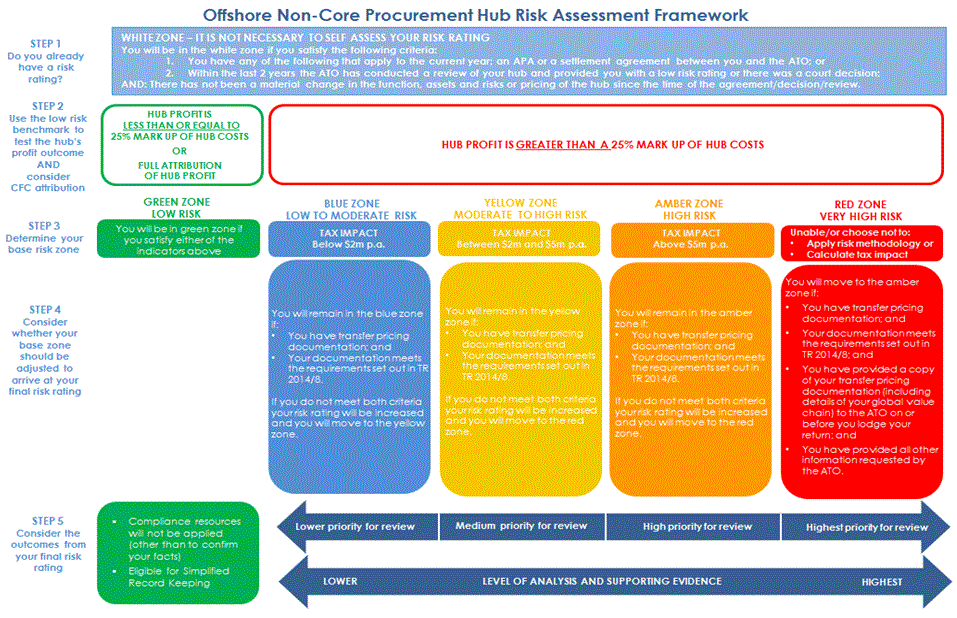
179. An overview of the risk assessment framework is provided at Attachment B.
Non-core product
180. Non-core products are goods and services that support the operations of a business; they are not converted into a finished item or resold. Examples may include office equipment, consumables, packaging, fuel, advertising, travel management and professional services.
It excludes items required to perform the core operations of a business, for example:
- goods purchased for resale by a distributor or retailer
- production inputs or plant and equipment employed by a manufacturer to produce goods
- heavy equipment and fuel used in mining operations, or
- skilled labour acquired by a professional services firm.
ATTACHMENT A – Core product procurement via overseas hub
The ‘Core’ goods distribution hubs diagram (posted in January 2017, with the original PCG) is in broadly identical format with Attachment B (for non-core procurement), which was only added, with Schedule 2, on 11 October 2018.
For ‘Core’ product procurement, the ‘green’ safe mark-up level is 100% of cost.
ATTACHMENT B – Non-Core procurement via overseas hub
For Non-Core procurement, the green (safe) mark-up level is only 25% of cost.
FJM 14.10.18
[LTN 196, 11/10/18; Tax Month – October 2018]
CPD questions (answers available)
- Is this primarily a practical guide to ‘safe’ levels of transfer pricing shifting of profits off-shore.
- What is the safe level of ‘mark-up’ on ‘core’ product distribution hubs?
- What is the safe level of ‘mark-up’ on non-core procurement hubs?
- Does the level of risk, for the ATO, increase with the amount of the tax at stake?
- Does the level of risk, for the ATO, increase when the taxpayer does nor adopt their preferred methodology?
- Does the level of risk, for the ATO, increase if the taxpayer doesn’t self-assess its own level of risk?
- Does the level of risk, for the ATO, increase if the taxpayer doesn’t have transfer pricing documentation that complies with TR 2014/8?
