


On 18 Dec 2017, the ATO finalised its Practical Compliance Guideline PCG 2017/4 on its compliance approach to cross-border related financing arrangements. It also posted a brief article, about the finalised PCG, including the main changes since the draft.
The guidance explains how taxpayers can price related party loans to demonstrate they are ‘low risk’ and avoid compliance action.
The Guidance applies to:
- a ‘financing arrangement’, as defined in section 995-1 of the Income Tax Assessment Act 1997 (ITAA 1997), or a related transaction or contract,
- entered into with a cross border related party – which is to say: a related party that is not a resident of Australia and which the cross border test under Subdivision 815-B of the ITAA 1997 applies; and
- to both inbound and outbound related party financing arrangements.
The PCG was first issued as draft PCG 2017/D4 on 16 May 2017. The final PCG incorporates the following changes:
- a clear articulation of the various indicators and how they interact with one another to determine the risk zone of a related party financing arrangement
- adjustment of some of the risk indicators to align with the Australian market
- a clearer explanation of the risk rating process, which makes it easier to self-assess the risk zone of related party financing arrangements.
[ATO website: PCG 2017/4, Posted Article; LTN 243, 19/12/17; FJM; Tax Month Dec 2017]
Extract from PCG 2017/4
The risk assessment framework
21. Our compliance approach will vary depending on the risk rating of your related party financing arrangement. The following principles will assist you to understand how we assess risk in relation to related party financing arrangements and generally allow you to assess your compliance risk.
22. If you fall outside the low risk zone, there is no presumption your related party financing arrangement is uncommercial or otherwise fails to comply with the Australian tax law. Falling outside the low risk zone means we consider your related party financing arrangement, or your treatment of that arrangement, is at risk of giving rise to an inappropriate tax outcome. Therefore, we will generally conduct some form of compliance activity to further test the taxation outcomes of your arrangement.
23. If we conduct a review of your related party financing arrangement, we may take account of other factors beyond those contained in this Guideline. This is because we will need to evaluate, among other things, the evidence that supports the commerciality of your related party financing arrangement.
24. The ATO’s related party financing arrangement risk framework is made up of six risk zones.
| Risk zone | Risk level |
| White | arrangements already reviewed and concluded |
| Green | low risk |
| Blue | low to moderate risk |
| Yellow | moderate risk |
| Amber | high risk |
| Red zone | very high risk |
What, when and how to risk assess your related party financing arrangement(s)
25. You will need to risk assess each financing arrangement you enter into with a related party that is not a resident of Australia:
- (a)
- for existing arrangements, either:
- (i)
- at the start of each income year with subsequent reviews during the year where additional information becomes available (for example if global group accounts are finalised two months after the start of the income year, the arrangement should be reviewed at that stage), and
- (ii)
- before income tax returns for the relevant income year are lodged and more contemporaneous financial information is available to assess outcomes for that income year
- (b)
- where a new arrangement is entered into during an income year, at the time it is entered into.
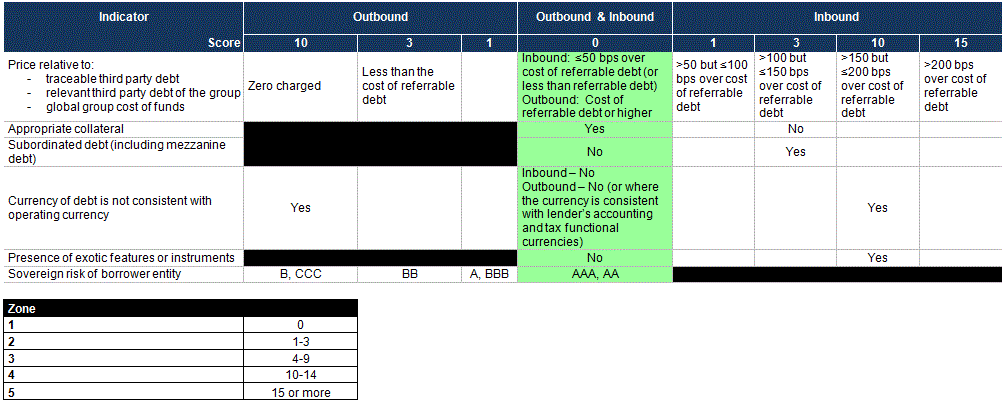
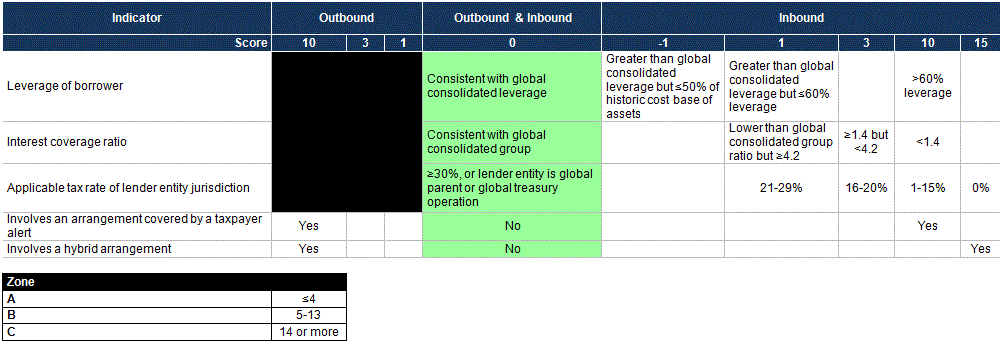
26. To determine the risk rating for your related party financing arrangement, you need to compare the conditions that actually exist in relation to your related party financing arrangement (or that have been reasonably assumed by you for the purposes of pricing your related party financing arrangement) with the indicators in the relevant schedule. Each indicator carries a particular score and the aggregate score for all relevant indicators will be your ‘risk zone’ number.
27. Each indicator is expressed either as:
- (a)
- a closed (yes/no) question, or
- (b)
- a qualitative or quantitative range.
28. The indicators and their relative weightings reflect features the ATO has observed:
- (a)
- from market data, relating to transactions between independent parties, obtained from a variety of sources widely used by companies
- (b)
- independent parties acting at arm’s length consider relevant in pricing financing arrangements, and
- (c)
- through its interaction with taxpayers, to be indicative of tax risk.
29. You should not adjust your arrangements so you sit higher within a particular range (as set out in the relevant schedule) merely because it does not change your risk zone. We will monitor outcomes for related party financing arrangements to ensure there is no such ‘drift’ within a range for an indicator. For example, if your gearing level (ratio of debt to book capitalisation) is historically 40%, we will monitor instances where your level of debt drifts to 50% but you remain within the same risk zone.
30. Your risk zone for an income year will reflect that of your highest risk financing arrangement. For example, if you have entered into three related party financing arrangements, two of which you assess as being in the yellow zone and one you assess as being in the amber zone, your overall risk zone will be amber.
31. Generally, the risk scoring is to be based on the most relevant finalised financial accounts available. However, if you feel a multi year average, a point in time approach or an alternative approach is more appropriate for your circumstances, you may request an exception to the general rule by emailing your rationale to PGIFinancing@ato.gov.au
32. You will be taken to be in the same risk zone for the entire year unless you subsequently enter into additional related party financing arrangements, which places you in a higher risk zone.
33. You are deemed to be in the white zone and do not need to self assess the risk rating of your related party financing arrangement where:
- (a)
- any of the following apply to a related party financing arrangement for the current year
- –
- an advance pricing arrangement (APA)
- –
- a settlement agreement between you and us
- –
- a court decision, and
- –
- we have conducted a review of your related party financing arrangement (where the review commenced on or after 1 January 2015) and provided you with a low risk rating for your financing arrangement
AND
- (b)
- there has not been a material change in the conditions of the related party financing arrangement including the terms, pricing, global group funding arrangements, comparability factors and/or risks since the time of the agreement, decision or review.
34. In performing your self-assessment you may consider certain features of your business or circumstances result in a risk-zone that is not reflective of your underlying risk. Where this occurs you may engage with us with your rationale and, if we find it acceptable, a white zone risk assessment may be granted.
35. For example, a capital intensive project in start-up phase may report a low interest coverage ratio which results in a higher risk zone. If this interest coverage ratio is the only indicator causing you to fall outside the green zone, you may engage with us to request a white zone risk assessment.
36. You must confirm eligibility with us before self-assessing yourself within the white zone.
…
Related party financing risk indicator guide
58. Determining your risk zone requires you to:
- (a)
- select the appropriate criteria for your financing arrangement (an outbound loan; that is, you’re an Australian taxpayer lending to a related party or an inbound loan; that is, you’re an Australian taxpayer borrowing from a related party)
- (b)
- identify the indicators (left hand column of the tables) relevant to your circumstances, and
- (c)
- determine your score (first row of the tables) for each indicator based on the actual conditions applying to your related party debt (or you have taken to exist for the purposes of pricing the related party debt according to arm’s length conditions).
59. Where the indicator is expressed as a range, your score for that indicator will be determined by reference to where you sit in that range.
60. An indicator with a score of 10 or 15 is individually capable of resulting in a risk score outside the green zone.
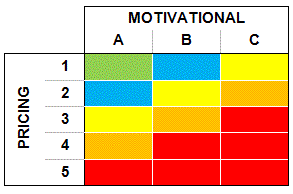
61. Your risk zone is determined by combining your outcomes under the pricing and motivational risk scoring tables (paragraphs 63 and 64 of this Guideline, respectively) according to the following matrix:
62. An explanation of each indicator (including how to calculate, where relevant) is given at paragraphs 66 to 104 of this Guideline.
63. Pricing risk scoring table.
64. Motivational risk scoring table.
Evidencing your self-assessment of your risk zone
65. The following are examples of evidence, which would be prudent to have in place in order to minimise the burden of any such fact checking, as described in paragraph 37 of this Guideline.
| Indicator | Example of evidence |
|
|
|
|
|
|
|
|
|
|
|
|
|
|
Definitions
[See paras 66 to 104 of the PCG]